
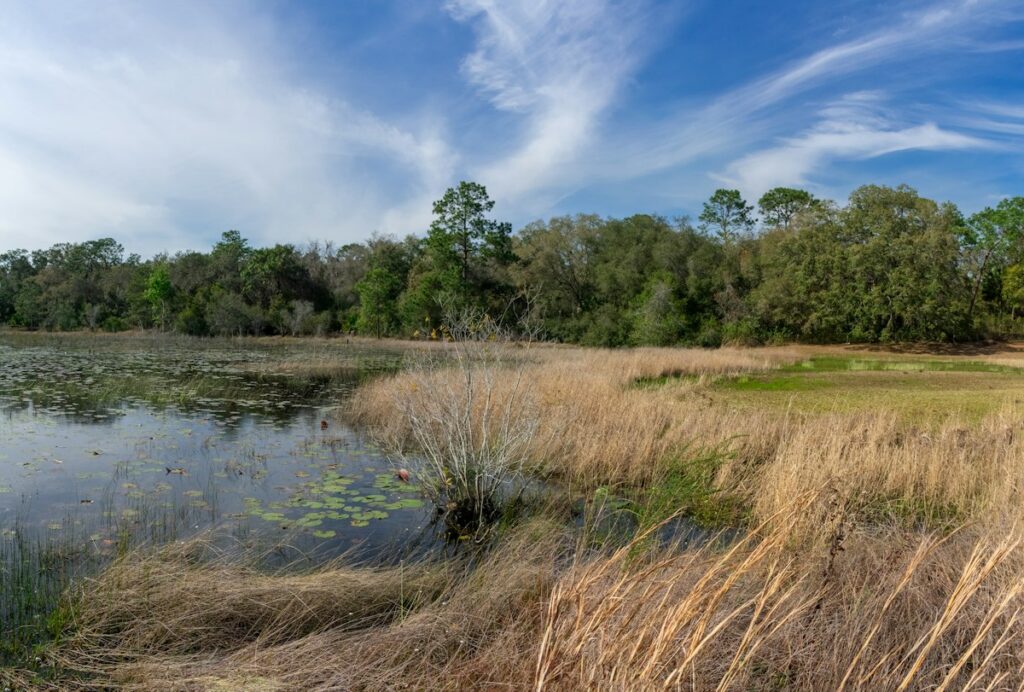
ERP & Stormwater Permitting
An Environmental Resource Permit (ERP permit) is Florida's permit for changing how water moves across and off your land. Creek prepares ERP permit applications and the stormwater and nutrient modeling behind them across 11 Southwest Florida counties.
- 2002
- The year Creek started serving Southwest Florida
- 11
- Counties, from Hillsborough to Collier
- 4
- Disciplines under one roof: civil, geotechnical, environmental, septic






Does my project need an ERP permit?
Rule 62-330.020(2) lists the triggers. Check anything that's true of your project, alone or together with other work.
The vehicle threshold is the one that catches people. A DeSoto County homeowner's access road across a wetland came to roughly 7,000 square feet, which brought in treatment swales on both sides of the road and both sides of the creek. Rule thresholds for dams, impoundments, and boat storage also apply; we check them on every site.
Changing a site that already has a permit is its own ERP question, and usually a county one too. Our site plan modifications page covers the minor and major paths, and this article covers whether a change needs a permit at all.
What an ERP permit covers, and what it doesn't
When you cover ground that water naturally soaks into, you lose the resource and you have to answer for where the water goes now. Erik Colleen, Creek's Vice President (Client Guide), would call it a water resource permit.
- CollectCatch basins take every drop that falls on the property.
- ConveyPipe sized to carry the design storm.
- Store and treatA pond or other storage holds the water and removes nitrogen and phosphorus.
- ReleaseA control structure lets it out at the rate the model has proven out.
| Item | ERP? | Detail |
|---|---|---|
| Stormwater | Covered | Collected in catch basins, carried in sized pipe, held in a pond, released through a controlled outfall at the modeled rate. |
| Wetlands and surface waters | Covered | Filling, crossing, or dredging in, on, or over a wetland, creek, or ditch. |
| County stormwater review | Separate | Counties review drainage on their own, through site plan review. "Are we talking state or county?" Usually both. |
| Army Corps of Engineers | Separate | Work in wetlands or waterways can also need federal authorization. |
| Site approval | Separate | Zoning, the county site plan, utilities, and the building permit. See commercial site work. |
Four permit paths
Not every project that crosses a threshold needs a full environmental resource permit. Which path fits depends on size, location, and what the site touches.
- Rule
- 62-330.051
- Usually fits
- A single-family home, duplex, triplex, or quadruplex with no wetland work, not part of a larger plan
- You file
- No ERP, but other permits still apply
- Rule
- s. 403.814(12), F.S.
- Usually fits
- Under 10 acres total with under 2 acres of impervious surface
- You file
- An electronic self-certification by a Florida-registered professional before construction
- Rule
- 62-330.402 and activity-specific general permits
- Usually fits
- Activities the state has pre-approved, such as certain utility lines, docks, and redevelopment
- You file
- A notice at least 30 days before work
- Rule
- Chapter 62-330; conceptual approval under 62-330.056
- Usually fits
- Everything that doesn't fit the other paths, plus phased or master-planned projects
- You file
- A full application with plans, calculations, and a surface water management report
Who issues the ERP permit in Southwest Florida
The water management districts review nearly all commercial site work. DEP takes single-family homes, standalone docks, coastal work, mining, utilities, and seaports.
| County | District |
|---|---|
| Sarasota, Manatee, DeSoto, Hillsborough, Hardee | SWFWMD |
| Lee, Collier, Hendry, Glades | SFWMD |
| Charlotte, Highlands | Split We check which side the parcel sits on first. |
Each district publishes its own Applicant's Handbook Volume II with its own design details. For every other office a civil project runs through, see the Southwest Florida building departments guide.
The new stormwater and nutrient standards
- 2020 · The Clean Waterways Act directs DEP to update the stormwater rules.
- June 28, 2024 · SB 7040 ratifies the rule; operation and maintenance requirements begin.
- Dec 28, 2025 · Section 8.3 performance criteria apply to applications completed after this date.
Modeling or calculations are now required instead of presumptive design. The engineer has to show, with numbers, how much nitrogen and phosphorus the site sends downstream before and after development, and that the design removes enough of it. DEP keeps its own summary of the dates and requirements at its ERP Stormwater Resource Center.
| Where your water goes | Phosphorus | Nitrogen | Also required |
|---|---|---|---|
| Most sites | 80% | 55% | Or post no higher than pre |
| Outstanding Florida Water | 90% | 80% | Or post no higher than pre |
| Impaired water | 80% | 80% | Plus a net improvement |
| Impaired and Outstanding | 95% | 95% | Plus a net improvement |
| Redevelopment, limited | 80% | 45% | Higher for Outstanding or impaired |
What's grandfathered
Existing permits aren't affected unless they go through a major modification. Minor modifications, earlier conceptual approvals, applications complete before the deadline, and local stormwater plans approved before January 1, 2024 in listed circumstances keep the old criteria. More in our article on Florida's new nutrient modeling requirements.
What the modeling actually involves
Two jobs, one report. The stormwater model (run in-house in AdICPR) puts the site through a battery of design storms. The nutrient model calculates pollutant load before and after development. Both depend on the survey and on soil and groundwater data, which our geotechnical engineering team gathers on site. The surface water management report can run to a couple of hundred pages on a commercial site.
After the permit
Every application includes an operation and maintenance plan and cost estimate. Since June 28, 2025, inspections need a qualified inspector, for the life of the site. Worth knowing before you buy.
What clients say about working with Creek
★★★★★No needless delays
"Most experienced, most organized and the best equipment by far. And the best of all is they are able to perform quickly without needless delays."
★★★★★Ready for inspection on short notice
"They were able to come out to my site on short notice and completed the compaction test promptly, ensuring everything was ready for my scheduled inspection."
★★★★★They went the extra mile
"They have shared their expertises, informations and workmanships with me… They helped me and they went extra mile for me to get the job done."
What it does to your site plan and budget

Always, always, yes, you need more land.
 Erik Colleen, Vice President (Client Guide)
A half-acre commercial lot that worked a few years ago often doesn't anymore.
We lay out a site in a set order: footprint and pavement, access, utilities, then stormwater and nutrient modeling, then landscaping. When the pond has to grow, a larger open pond takes land, and a chambered system under the parking lot saves land but costs a lot more. One client's pond would have cost more than three times the lot next door, so they bought the lot and graded a pond on it.
Frontage on a state road or a creek crossing can raise the bar again; our watershed analysis page covers those cases. None of this is high stakes if you find it out early. The cheapest time to ask is before you close; a lot feasibility study is where we'd start.
What to expect working with Creek
- First conversationSend a parcel ID, survey, concept sketch, or reviewer's comments. We'll tell you which permits are likely in play, state and county.
- Pre-applicationWe meet the county, the water management district, and FDOT where there's state road frontage, before design. You're welcome in those meetings.
- Field dataSurvey, soil borings, and permeability testing.
- Design and modelingSite plan, stormwater model, and nutrient calculations, wrapped into the surface water management report.
- Application and reviewWe assemble the application and answer the agency's requests for additional information.
- Permit, construction, and afterThe operation and maintenance plan travels with the site.
Civil, geotechnical, environmental, and septic engineering under one roof, serving Southwest Florida since 2002.
Locations we serve
We're based in Port Charlotte and serve all of Southwest Florida, especially these counties:
- Charlotte County: Port Charlotte, Punta Gorda, Deep Creek, Rotonda West, Cleveland, Burnt Store, Charlotte Harbor
- Collier County: Naples, Everglades City, Naples Manor, Goodland
- DeSoto County: Arcadia, Fort Ogden, Nocatee
- Glades County: Moore Haven, Buckhead Ridge, Palmdale, Lakeport, Ortona
- Hardee County: Wauchula, Bowling Green, Zolfo Springs, Ona, Limestone
- Hendry County: LaBelle, Harlem, Clewiston, Montura
- Highlands County: Sebring, Avon Park, Lake Placid, Lorida, Venus
- Hillsborough County: Tampa, Ruskin, Plant City
- Lee County: Bonita Springs, Fort Myers, Cape Coral, Estero
- Manatee County: Bradenton, Lakewood Ranch, Bayshore Gardens, Palmetto
- Sarasota County: North Port, Venice, Sarasota, Englewood, Nokomis