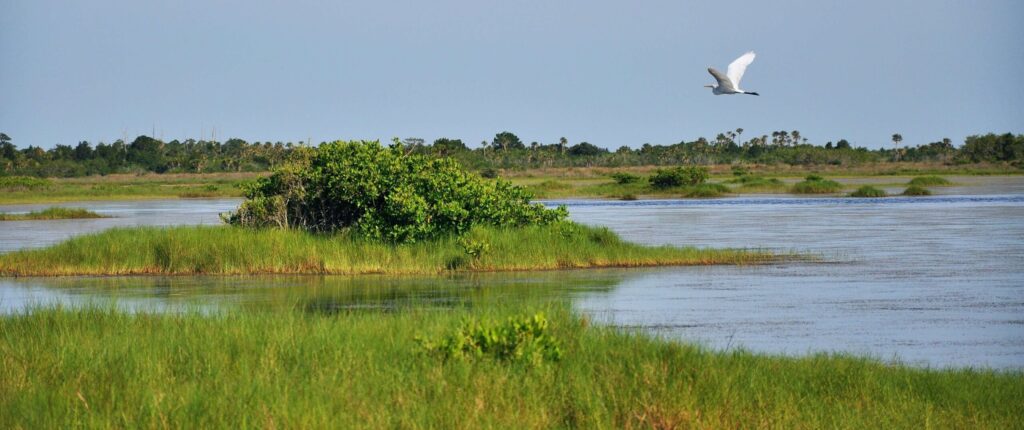
You bought the canal lot, or the waterfront commercial parcel, and there’s a wall of mangroves between you and the water. The neighbor says you can trim them to six feet. The dock builder says you can’t touch them. Someone at the marina says you need a state permit for anything over your head. All three of them are partly right, which is the problem.
The rules live in a 1996 state statute, a set of exemptions administered by the Florida Department of Environmental Protection, and a handful of local governments that run their own programs. There’s no reason a property owner would know all of that, and there’s no single page that puts it together. So here it is, from a firm that does this permitting in Charlotte, Sarasota, Lee, and Collier counties.
The short version: trimming mangroves is regulated, removing them is permitted and mitigated the same way a wetland impact is, and the line between those two is where most people get into trouble.
Why the state cares this much about a shrub (and why you should too)
It’s fair to look at a mangrove fringe and see an obstacle to your view. Here’s why the state sees something else, in the order that matters most to a property owner.
They hold the shoreline and take the hit from storms. Mangrove roots bind the bank, and the forest absorbs wave and surge energy before it reaches what’s behind it. Scientists with the Conservancy of Southwest Florida have monitored the mangroves at Clam Bay in Collier County since 1999. When Hurricane Ian came through in 2022, their estimate was a storm surge of six to eight feet in Pelican Bay, while the surge inside the mangrove forest reached eight to ten feet. The forest took the water so the neighborhood took less. If you own waterfront property, that’s the benefit you’re actually paying for.
They’re a nursery. Roughly three quarters of Florida’s game fish and about 90 percent of South Florida’s commercially caught fish and shrimp use mangroves at some point in their lives, according to the Conservancy. The trees also filter water, trap sediment, and store carbon.
And Charlotte Harbor has already lost most of them. The Charlotte Harbor Environmental Center estimates the harbor has lost about 60 percent of its historic mangrove habitat to development and other human causes. That’s why enforcement here is strict, and to be fair to the agencies, it’s a reasonable position. The easiest forest to protect is the one that’s still standing.
Can I trim the mangroves on my own property? Yes, within limits
The governing law is Florida’s Mangrove Trimming and Preservation Act (Sections 403.9321 through 403.9334, Florida Statutes). It sets up three tiers: trimming that’s exempt from permitting, trimming that needs a general permit, and work that needs an individual permit. Most residential owners live in the first tier, as long as they stay inside its limits.
Exempt trimming, in plain language. If the mangroves along your shoreline are ten feet tall or shorter, you can trim them yourself, to a height no lower than six feet. The exemption applies to the riparian mangrove fringe (roughly the band of trees within 50 feet waterward of the most landward trunk), not to mangroves deeper in a wetland. If your shoreline is 150 feet or shorter, you can trim the whole fringe; if it’s longer than 150 feet, only 65 percent of it. And the exemption only holds if no herbicide or other chemical is used to remove the foliage.
Above ten feet, you need a professional. A professional mangrove trimmer (PMT) is someone who has demonstrated to DEP or a delegated local government that they can trim in a way that keeps the trees alive. The tiers work like this:
| Mangrove height | Who can trim | What’s required |
|---|---|---|
| 10 feet or less | The property owner | Exempt, within the limits above |
| 10 to 16 feet | A professional mangrove trimmer | PMT does or supervises the work |
| 16 to 24 feet | A professional mangrove trimmer | PMT plus additional restrictions |
| Over 24 feet | Permit holder | DEP or delegated local government permit |
Trimming versus alteration: the line that earns a notice of violation
The statute draws a hard line between trimming and alteration. Trimming is cutting within the rules so the trees survive. Alteration is anything that defoliates, damages, or removes mangroves beyond what an exemption or permit allows. Hat-racking (cutting the tops flat and stripping the canopy) is the classic example. So is clearing them with a machine.
It doesn’t have to be deliberate. This summer, a contractor in Cape Coral was clearing Brazilian pepper, Australian pine, and other exotic vegetation from a 47-acre development called Seven Islands. Along with the exotics, an estimated 570 feet of red mangrove shoreline came out. The developer said it was a mistake, and according to the reporting, the plan was to leave the mangroves along the spreader waterway and put the seawall upland of them. The South Florida Water Management District issued a notice of violation anyway. In 2019, a similar clearing job at Four Mile Cove in Cape Coral ended the same way: replant and mitigate.
Read that as a construction-sequencing story, because that’s what it is. The plan protected the mangroves. The person in the excavator didn’t have the plan. That’s why we flag clearing limits in the field, hold a pre-clearing meeting with the crew, and put an engineer on site when the machines start. It’s not a big cost, and it’s a lot less than restoration.
And if you’ve already got a violation on your hands, it’s not high stakes, because there’s always a solution. Violations get resolved through restoration and mitigation. The point of this article is that it’s far cheaper to plan than to restore.
When you actually need to remove mangroves: it’s a wetland permit
Here’s the sentence that changes the conversation for anyone building near the water: mangroves have to be mitigated by the same kind of permits that wetlands do.
If your project needs mangroves gone, not trimmed but gone, for a dock, a seawall, a driveway, a building pad, or a canal cut, you’re no longer in the trimming statute. You’re proposing an impact to a jurisdictional wetland or surface water, and that goes through the Environmental Resource Permit (ERP) process with DEP or your water management district, and through the U.S. Army Corps of Engineers where federal jurisdiction applies. It’s the same path we walk for any wetland impact in Southwest Florida.
That path has a fixed order, and the agencies expect you to follow it. Avoid the impact if the site allows it. Minimize what you can’t avoid. Mitigate what’s left, by replanting on site, restoring somewhere else, or buying credits at a mitigation bank. Mangrove mitigation is harder than it sounds, because a replanted mangrove only lives if the tide can reach it, which means the hydrology has to be right or the mitigation fails.
The first step in every one of these projects is a wetland delineation: flagging where the jurisdictional line actually falls, so you know what you’re dealing with before you design around it. We do that work ourselves, in the field, rather than sending it out, because the line decides everything that comes after.
Your drainage plan can kill mangroves you never touched
This is the part environmental groups don’t usually write about, because it’s an engineering problem.
“Hydrology is a mangrove’s Achilles heel.” That’s Kathy Worley, an environmental scientist with the Conservancy of Southwest Florida, and the story behind it is Fruit Farm Creek in Collier County. Scientists studied that forest from the late 1980s, when it was healthy. In the 1990s it collapsed, and the die-off left an area so dead that even the mosquitoes stayed away. Nobody had cut it down. Researchers traced the cause to altered hydrology from surrounding development: the tidal water simply couldn’t move through the forest the way it used to. In 2010, the Conservancy and its partners started a restoration, and instead of planting trees, they restored the tidal channels. In the smaller die-off area, the mangroves came back on their own once the water did. The larger area has been barren since 1995; the peat has collapsed and the soil has gone oxygen-starved, and it may never recover.
Now translate that to a lot. Fill placed where it blocks tidal exchange. A swale that traps water in the fringe for weeks. Equipment staged on the roots until the soil compacts. A seawall set where it cuts the trees off from the tide. None of those is a mangrove violation on the day it happens, and every one of them can kill the fringe over a few years, which is when the agency notices.
These are site plan decisions, and they’re made by whoever designs your grading and drainage. This is the reason we keep civil design and environmental permitting under one roof. The same engineer who’s laying out your stormwater is the one who knows where the tide needs to go.
Seawall, riprap, or living shoreline?
On a canal or harbor lot, you usually have three options for the water’s edge, and each does something different to the mangroves. A seawall is a hard vertical wall; it holds the land but reflects wave energy and, placed wrong, walls the fringe off from the tide. Riprap is placed rock; it dissipates energy and can be built with the trees rather than through them. A living shoreline uses vegetation, sometimes with a low breakwater or sill, to hold the bank and absorb energy while the mangroves do the rest.
Which one is right depends on the lot, the exposure, the neighbors’ walls, and what’s already growing. There isn’t a universal answer, and anyone who gives you one without walking the shoreline is guessing.
What’s changing. In March 2026 the governor signed Senate Bill 302, which took effect July 1. It directs DEP to develop statewide standards for nature-based coastal resilience and, by January 1, 2027, to build a more consistent permitting path for projects like living shorelines, mangrove replanting, and hydrological restoration. It also calls for identifying and monitoring threats to mangroves. It doesn’t replace any of the trimming or alteration rules above. What it may do, by 2027, is make the living shoreline option easier to permit than it is today.
Who issues the permit in your county
For most of our service area, the permitting authority for mangrove trimming and alteration is the Florida Department of Environmental Protection. Seven local governments statewide have taken delegation of the program and run their own: Miami-Dade, Broward, Hillsborough, and Pinellas counties, the Town of Jupiter Island, and two in our area, Sarasota County and the City of Sanibel. Inside a delegated jurisdiction, the local government issues the permits, and a locally registered trimmer’s exemptions only work inside that jurisdiction. In Charlotte County, Lee County outside Sanibel, and Collier County, you’re working with DEP.
Removal and mitigation, as above, run through the ERP process with DEP or the water management district regardless of where you are.
Questions worth asking before you touch a mangrove
Before you, your landscaper, or your contractor cuts anything, you want to ask:
- “How tall are these, and how long is my shoreline?” That’s the whole exemption test.
- “Is what I want trimming, or is it alteration?” If the answer involves a machine, it’s alteration.
- “Which agency has jurisdiction on my lot: DEP, the county, or the city?”
- “What does my site plan do to the tide?” Ask your engineer, not your landscaper.
- “If I need to remove some, what does mitigation look like, and can it be done on site?”
- “Who’s going to be standing next to the excavator when clearing starts?”
Find out before anything gets cleared
The Calusa Waterkeeper’s Jason Pim put it plainly in a recent interview: replanting and mitigation are nice, but the most important thing you can do to protect mangroves is to not harm them in the first place. We’d add the property owner’s version: the cheapest mangrove permit is the one you figured out before the crew showed up.
If you’ve got mangroves on or next to a site in Charlotte, Sarasota, Lee, or Collier County, start with a delineation and a conversation. We’ll tell you what’s allowed, what needs a permit, and what your plan does to the water before any of it costs you anything.
Frequently asked questions
Can I cut mangroves on my property in Florida?
You can trim them without a permit if they’re ten feet tall or shorter, you leave them at least six feet, you stay within the riparian fringe, and you follow the shoreline and foliage limits in the Mangrove Trimming and Preservation Act. Anything taller needs a professional mangrove trimmer or a permit. Removing them is a wetland impact and needs an Environmental Resource Permit.
Do I need a permit to trim mangroves in Charlotte County?
Not for exempt trimming on mangroves ten feet or under. Above that, the work needs a professional mangrove trimmer, and above 24 feet it needs a permit from the Florida Department of Environmental Protection. Charlotte County isn’t a delegated local government, so DEP is the authority.
What is a professional mangrove trimmer?
Someone who has shown DEP or a delegated local government that they can trim mangroves in a way that keeps the trees alive. The Act requires one for any mangrove over ten feet tall.
What happens if you cut down mangroves without a permit in Florida?
It’s treated as an alteration. The agency (DEP, the water management district, or a delegated local government) can issue a notice of violation and require restoration and mitigation. It gets resolved, but it costs far more than planning would have.
Is mangrove removal the same as a wetland permit?
Yes. Removing mangroves is an impact to a jurisdictional wetland or surface water, permitted through the Environmental Resource Permit process, with mitigation, the same way any other wetland impact is.